
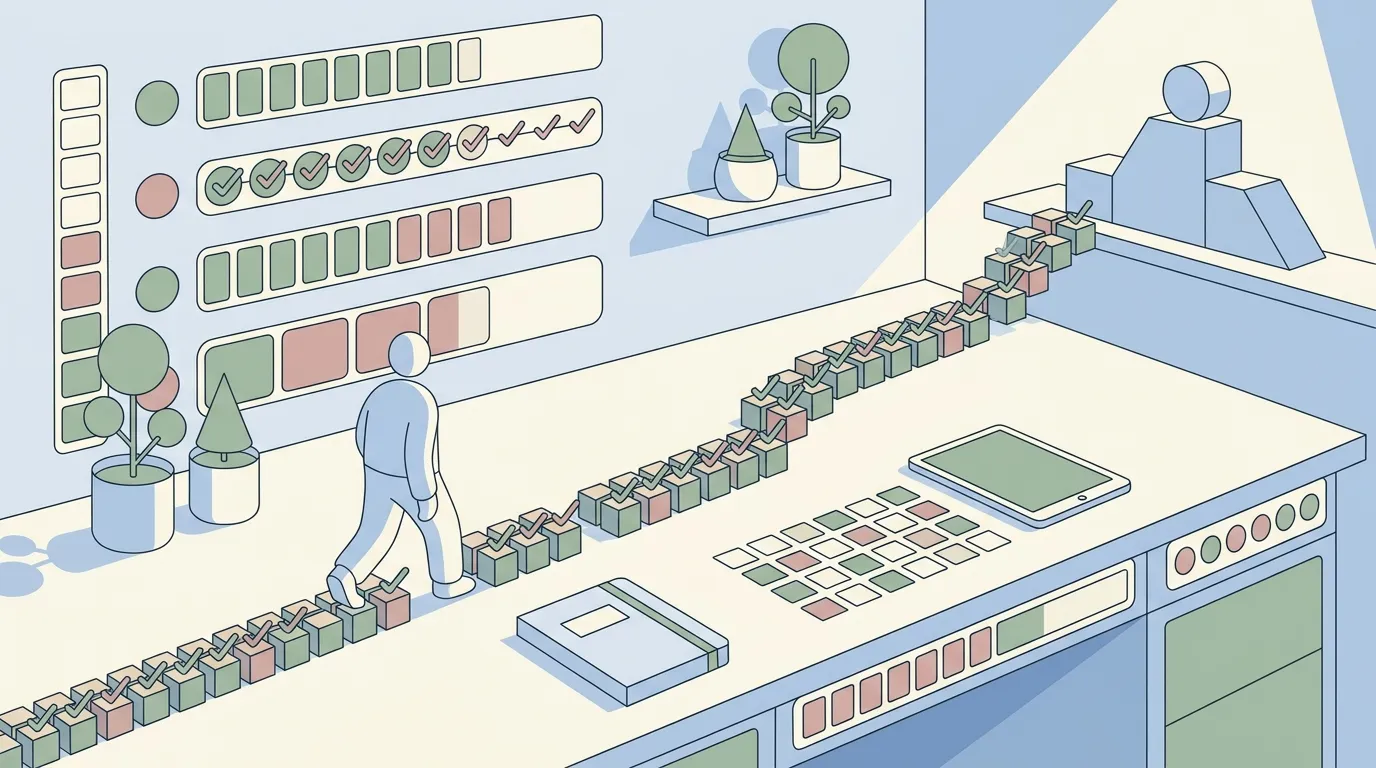
A goal lives in the future. It describes a version of you that doesn’t exist yet, which is part of why the goals in life you care about can feel motivating and slightly hopeless at once. You can’t actually do a goal, but you can do is the next small thing that points towards it, then the same thing tomorrow.
Think about the last streak you kept going. Days without a cigarette, or a run of ticks on a wall calendar you didn’t want to break. That reluctance to snap a visible chain is the whole engine of habit tracking, and it is a large part of how to achieve goals that would otherwise stay abstract. It takes the goals in life you keep meaning to get round to and turns them into a row of marks you’d feel bad abandoning.
So let’s get into the how-to. We’ll look at how to take the goals in life that feel too big to begin and break them into a daily action you can log without thinking. From there it’s a matter of checking back once a week to see what held, and repeating that action day after day until… voila! You’re standing in front of your goal! Let’s get started :)
Why habit tracking works better than raw motivation
If you’ve tried to build a better routine before, you don’t need a lecture; you know how it goes. The first few days are fine, then something throws you off. It’s not a willpower problem and it doesn’t mean something’s wrong with you, but rather that the tools you’re using don’t really fit your flow.
You do not rise to the level of your goals. You fall to the level of your systems.
Research suggests that about 40% of daily behaviors are habitual, so a big part of everyday life is already running on repeat (James Clear). Learning to work with those patterns rather than fight them with pure brute force makes change feel less stressful, which is what we want!
Research on habit formation suggests the average habit takes about 66 days to start feeling more automatic, not 21 days like many people have heard. That’s a big difference! The same source says the full range can stretch from 18 to 254 days. A good reminder to stay patient – It all adds up. You’ve just gotta do it every day!
Tracking helps because it lets people see their behavior more clearly. Research summaries covering more than 19,000 participants found that self-monitoring is one of the strongest behavior-change tools. In laymans terms: when people notice what they’re doing, they’re more likely to improve.
A habit tracker is a simple way to log your behavior, and the mere act of tracking a behavior can spark the urge to change it.
That’s why tools like ours at Everyday support you reaching your goals in life by keeping habits visible with a beautiful interface, showing streaks, and making progress easy to spot across days. You also get a simple view of how consistent you’ve been. Seeing that strong, vibrantly coloured chain can make it easier to keep the habit going and not lose the rhythm.
Start with a goal, then shrink it into a daily habit
To reach goals, you need to start by making them smaller than your ego tells you that you want. Big outcomes feel exciting and inspiring, sure, but they’re hard to keep up, especially once the first rush fades and real life gets in the way. Daily actions are boring, in the best way. They stay simple.
Here’s a simple way:
1. Pick one real goal
Choose something that matters, for example:
- Get healthier
- Study with better focus
- Save money
- Write a book
- Reduce stress
2. Turn it into a habit
Ask what this looks like on a regular day.
- Get healthier becomes a 10-minute walk
- Study better becomes going over notes for 15 minutes
- Reduce stress becomes taking 3 deep breaths after lunch
3. Make it tiny
Small habits are easier to keep doing. If needed, make the action even smaller.
- Read one page
- Do five pushups
- Write one sentence
4. Use an if-then plan
Keep habit-building simple. Write your action in this format:
- If I make coffee, then I will write my top task
- If I sit at my desk, then I will study for 10 minutes
- If I brush my teeth, then I will stretch for 30 seconds
Want more help with small routines? Begin here. Read How to Form New Habits: For Beginners Who Hate Routines and Habit Stacking for Beginners: How to Make It Work For You.
Use tracking to build consistency, not pressure
A lot of people quit because they treat tracking like judgment, but that misses the point. The best tracker is simple. Really simple. It answers one question: did I show up today?
Here are common mistakes that make habit tracking harder:
Tracking too many habits at once
Start with one or two habits. Ten sounds ambitious, but tracking (not to mention doing!) that many just adds stress and potential overwhelm.
Making the habit too large
A 1 hour workout is so much harder to keep up than putting on your shoes and going out for a 10-minute power walk. Ditch that ego and shrink the habit!
Using a weak cue
A strong cue happens nearly every day. Making tea, opening your laptop, or getting into bed are regular moments that make a cue feel strong.
Treating one missed day like failure
Missing once is normal. Perfect streaks aren’t the be all and end all – and with Everyday, they’re not the aim! That’s far too much pressure that sets you up to fail. It works better to notice patterns instead. But it’s a different story if burnout or low energy gets in the way; if this sounds like you, Burnt Out? How To Find Motivation With Everyday offers a useful next step.

Add weekly reviews and accountability for better results
Daily tracking helps people get started. A weekly review shows what’s really working. Ask:
- Which habit felt easiest this week?
- Which one kept getting skipped?
- What time or cue worked best?
- What should be smaller next week?
Progress updates help people stay on track. Accountability helps too.
Nobody needs to post every habit online. They can just tell a friend, partner, coach or study buddy what they’re tracking.
Self-monitoring is one of the most effective strategies for reaching goals.
Habit trackers also work well for students and working professionals. Students might track study blocks or even sleep, while professionals can track planning, movement or focus sessions. Different goals, same idea.
Why simple tools are winning right now
Habit tracking is no longer a niche idea. It’s turning into a mainstream part of digital wellness and productivity. The market is growing fast, with habit tracking apps expected to reach USD 1.94 billion in 2025 and USD 2.22 billion in 2026, alongside a projected 14.2% growth rate (Straits Research).
That growth makes sense. People want tools that help with time management, stress management and resilience training without creating more work. Less friction, more support.
Recent app trends show what users want most:
- streak-based motivation
- simple design
- flexible reminders
- cross-platform habit tracker access
- progress views that are easy to read
More people are stepping away from heavy systems and choosing simpler ones instead. They want something calm, something that feels useful, not demanding.
A simple plan you can start today
If you feel inspired but also a little overwhelmed, keep it simple – you don’t need a total life overhaul. Instead, choose one habit you can count on yourself to repeat, even on days when motivation drops and everything else feels a little too big.
Try this today:
- Pick one goal in life that matters right now.
- Turn it into one tiny daily action.
- Attach it to a routine you already have.
- Track it for the next 14 days.
- Review it once a week and adjust.
Around 43% of daily actions are already habitual, which means repeated behavior is already shaping a large part of life (APA). The chance is to shape more of those actions on purpose instead of leaving them on autopilot.
Broad resolutions often fail. Some summaries show only 9% of people fully complete New Year’s resolutions (Ohio State University). So if the old approach hasn’t worked, change is still possible. It just means a better system can make the next step feel easier.

Now make your goals easier to follow
The best answer to achieving goals isn’t chasing more motivation. It’s making action easier to repeat. Habit tracking helps by turning hope into evidence and giving people a way to see progress and start again quickly when life gets in the way of your goals.
Download the Everyday app now. Pick one small, doable habit. Log it every day, and look back once a week. Over time, you’ll see that those choices help you stick with the habit. It really is that simple.
Over time, small actions stop feeling small. They become proof. Proof that people can follow through. Proof that goals in life aren’t just ideas, but things people keep working on, little by little, day after day.
That’s how real change happens.