

If structured routines make you cringe, you’re not broken and you’re not lazy. You’re probably just tired of the version of self-improvement that asks you to wake at five, follow a colour-coded schedule and never have a bad week. That model works for a particular kind of person. For everyone else trying to work out how to form new habits, it manufactures failure before the actual habit has had a chance to take.
Building new habits doesn’t require a personality transplant. What it requires is something almost embarrassingly small – small enough to do on the worst day of your week, repeated until it stops feeling like effort. A daily tracker is one of the better ways to make that small thing visible to yourself, because the early weeks of a habit are exactly when the progress is least obvious and the urge to quit is highest.
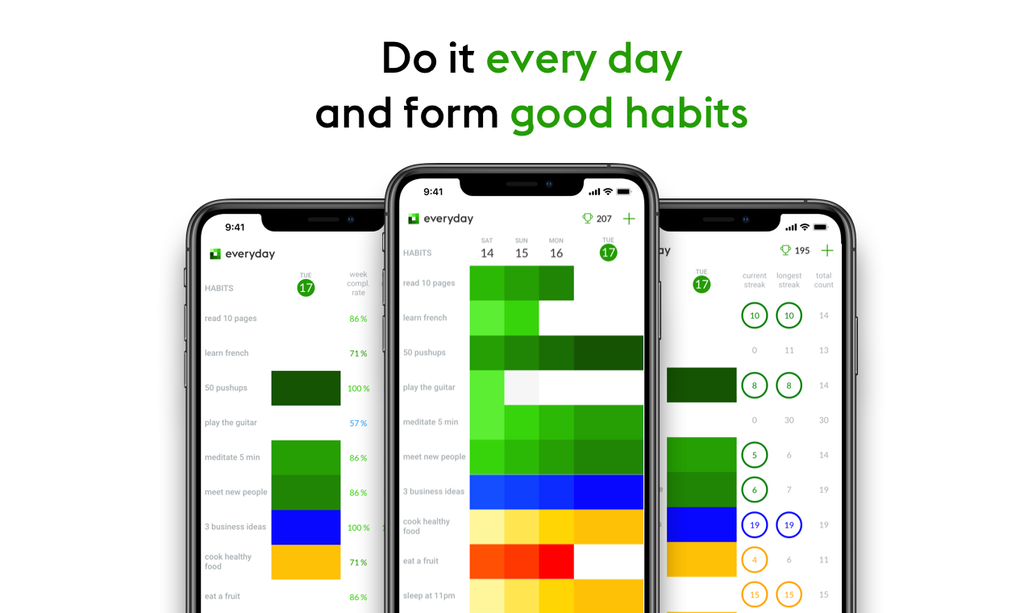
This guide covers how habits actually form, why small repeated actions outperform ambitious plans almost every time, and how to build a routine that survives a bad Tuesday. It also looks at the apps worth using – including our Everyday app, the simple, beautiful habit tracker designed for people who want to keep up a few small habits without the gamified noise most apps add.
Stop Chasing Motivation and Start Using Cues to Form New Habits
A lot of beginners think they fail because they are not motivated enough. But research on habits usually points to something else. Repeated behavior often happens because the same action keeps coming up in the same setting again and again, and that is really how it works. According to the American Psychological Association, 43% of everyday actions are enacted habitually while people are thinking about something else (American Psychological Association). So in daily life, behavior often depends more on context than on steady effort, and that is probably more common than most people think.
We think we do most things because we make decisions or we’re asserting willpower, but instead our research shows that a lot of human behavior is repeated often enough in the same context to form habits.
What actually moves people to change a behaviour is rarely inspiration. It’s a reason that matters today and a next step small enough to take before the reason is forgotten. Waiting to feel ready is the slowest route there is.
Habit stacking works on the same logic: you attach a new habit to one that already exists. Try using positive affirmations like ‘I will’:
- After I brush my teeth, I will stretch for thirty seconds.
- Once the coffee is on, I will drink a glass of water.
- After I open the laptop, I will write the first sentence of whatever I’m working on.
- Before I shut the laptop at the end of the day, I will write tomorrow’s first task.
The trigger has to be something that already happens without thinking. That’s what does the work – the existing routine carries the new habit along until the new habit can stand on its own.
That setup usually feels easier than trying to follow a strict schedule. There is less pressure. In this view, it is often easier to keep doing because the cue is already there. If more small examples would help, this guide to mini habits covers that.

How to Form New Habits When You Hate Routines
Starting smaller is the part most people gloss over. They pick four habits at once, set up an elaborate tracking system, miss two days in the first week, and stop. The failure isn’t discipline. It’s scope… It usually goes better when the habit feels almost too easy. Really, much easier!
A 2024 meta-analysis covering 20 studies and 2,601 participants found that the median time to reach habit automaticity was 59 to 66 days, with a very wide range from 4 to 335 days (PMC / NIH).
Individuals should anticipate a timeframe of at least two to five months to develop automaticity in new health habits, rather than the commonly cited 21-day period.
A simple beginner-friendly plan looks like this:
1. Pick just one habit
Choose one action that really fits your real life (I think that often matters). Not the fantasy one (you know, the ideal version).
2. Make it tiny
Read one page. Maybe do one push-up. If you can, open your planner.
3. Tie it to a regular cue
Use something you already do every day; honestly, that usually makes it easier to stick with.
4. Track it right away
Mark it done as soon as you finish it, don’t wait. Fast feedback usually matters most, especially right after.
5. Don’t skip twice
Missing once is normal, but missing twice is often the start of a new pattern.
This approach stays flexible instead of rigid, which really helps. It works well for students, busy workers, and anyone whose energy changes a lot. That flexibility is often really useful. If that sounds like you, this article on building good habits when your energy changes daily is worth a read; you’ll probably relate. You might also enjoy reading Habit Formation for Beginners: A 7-Day Challenge That Works! for more strategies on how to form new habits.
Why a Daily Tracker Makes Behavioral Change Easier
A daily tracker is not there to judge anyone. It helps people notice their progress, which really matters when change still feels slow.
Recent research from the University of South Carolina found that 66.34% of daily behaviors were habitual, and 87.6% of habits were habitually executed (University of South Carolina). Put simply, habits shape a huge part of daily life. Because of that, even one small change can have a bigger effect on routine management and long-term consistency.
Our study shows that two-thirds of what people do each day is sparked by habit, and the majority of the time those habits are intentional.
The best apps for self improvement help in a few key ways:
- It shows whether the habit actually happened
- It lets people see effort add up over time, like a streak or chain
- It gives a reminder before the habit slips out of mind
- It can show patterns, such as harder weekends or stressful workdays
Usually, the best systems are simple. Really simple. In the brand’s view, many people do better with a clean board and a quick check-off system than with complicated scoring, too many settings, or endless features. That helps explain why visual tools and streak-based apps are still so popular. Want a closer look at that? There’s more here: Daily Routines: How to Track Your Habits for Maximum Impact. You might also find value in How to Track Habits Without Stressing Yourself Out, which shows how to form new habits without adding pressure.

Make the Habit Easier Than the Excuse
The fastest way to change a behaviour is to lower the cost of starting it. Most habits don’t fail at the action – they fail at the threshold just before the action, the moment where it would be easier to do nothing. Reduce what has to happen in that moment and the habit takes care of itself.
A few ways to do that:
Set the environment the night before. Book on the pillow. Trainers laid out by the door.
Shrink the entry point until it’s almost embarrassing. Three slow breaths while the kettle boils. Not a workout – putting the trainers on and standing up. The trick is that once you’ve crossed the threshold, you usually keep going.
Use events as triggers, not clock times. “At 1pm” assumes a day that goes to plan. “After lunch” works on the days that don’t. Tie habits to things that happen regardless of how your schedule collapses – meals, the kettle, the school run, shutting the laptop.
Write the rule so a tired version of you can follow it. “Write one sentence after dinner” is followable. “Be more productive” isn’t a rule, it’s a wish.
Underneath all of this is the same principle: repeating an action in a stable context is what turns it into a habit. Once the cue is consistent, the action stops requiring decision – which is the whole point, because decisions are where habits leak away.
One thing worth noticing: small habits sometimes pull other things behind them. Two minutes of planning before bed often does more for the next day than an hour of trying to plan during it. A glass of water before coffee changes what the rest of the morning feels like. The first habit isn’t the prize – it’s the doorway… For more on this concept, read The Power of Keystone Habits: Transform Your Daily Routines.
Best Apps for Self Improvement and Habit Tracking
There isn’t one best choice for everyone, but a few tools are especially useful when you’re just getting started. The best apps for self improvement usually do a few things really well: they make progress easy to see, ease some of the pressure, send reminders, and feel nice enough that you’ll actually want to open them every day, which is often a bigger deal than it sounds.
Some popular options include:
- Everyday for simple, beautiful habit tracking on all your devices
- Habitica for game-style motivation and rewards
- Finch for self-care, encouragement, emotional support, and a more supportive feel overall
- Streaks for clean habit tracking and customization on Apple devices
For a wider roundup, there’s also this guide on the best apps for self improvement, which helps compare different styles. That’s probably the main thing most people need, since the right fit usually depends more on style than on features alone. You can also explore Best Reclaim.ai Alternatives 2026: Cheaper, Better Habit Apps to find more tools that support how to form new habits effectively.
So what should you look for in a daily tracker?
- simple design
- reminders that help without getting annoying
- visual progress tracking
- easy check-ins
- sync across devices if you switch between phone and desktop. Everyday has you covered here!
That last point is particularly important. In many cases, it’s much easier to keep a habit going when it stays visible on both phone and desktop, wherever you are.

Your Questions, Answered
Isn’t motivation the main thing?
No – and waiting for it is how most habits die. What motivates people to form new habits is structure: a clear trigger, a habit small enough to do on a bad day, and somewhere to log it. The people who keep habits going aren’t more inspired than you. They’ve just built systems that work when inspiration isn’t available.
What’s the best first habit?
Whichever one you can do tomorrow morning without thinking about it. A glass of water before coffee. Thirty seconds of stretching out of bed. One sentence in a notebook. The specific habit matters less than picking one you won’t have to negotiate with yourself about.
Should I track every day?
Yes, if the tracking takes under ten seconds. A daily tick keeps the loop tight and makes weekly patterns visible.
What if I miss a day?
Don’t miss twice. One gap is recovery; two gaps is a new pattern forming. If you’ve already missed two, restart on a Monday with a smaller version of the habit – not because Mondays are magic, but because a defined restart point is easier to commit to than “soon.”
Make It Easy For Yourself
If there’s one thing to take from this guide, it’s that building habits should feel ordinary and quite frankly a bit boring, not dramatic. The best daily habits are small and clear, and tied to something that is already part of your day.
So what helps most? Start with one habit today and make it easy enough that you’re not going to talk yourself out of it. Then track it, track it again (and again and again). Notice the patterns, and change the cue if you need to. And keep going! You don’t need a new personality; you just need a better way to start.
Download the Everyday app. Choosing one habit and checking in each day lets progress develop with very little pressure. Over time, those simple check-ins build momentum. Ultimately, goal tracking supports authentic, sustainable achievement that grows naturally. Every day!