
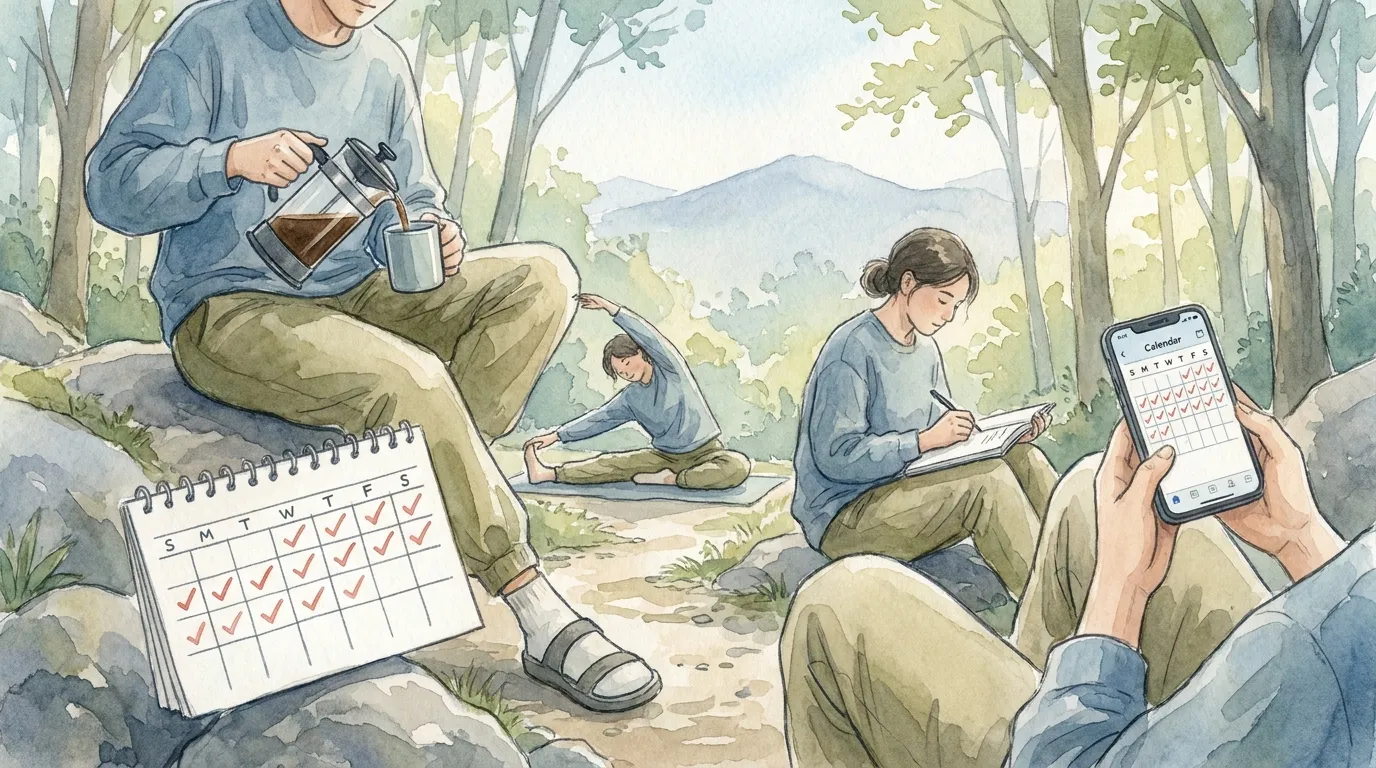
If building a new habit has ever held together for a few days and then collapsed, that is not a sign of laziness. It usually means you were relying on memory and motivation alone – and that is hard for almost everyone. Habit stacking makes the process easier by linking a new behaviour to something that already happens every day.
So instead of thinking, “I should remember to meditate,” you attach the new habit to a settled routine like brushing your teeth or making coffee. The older habit then becomes a cue for the new one. That is a big reason habit stacking is often one of the easiest ways to improve time management and cut down on decision fatigue. In many cases, it also makes consistency easier to maintain over time.
For beginners, that can make a real difference. Research suggests that about 40% of daily behaviors are habitual, so a big part of everyday life is already running on repeat (James Clear). Learning to work with those patterns rather than fight them makes change feel less stressful.
Willpower is not a great strategy for building habits. Habit stacking sidesteps the problem by pinning new behaviours to ones you already do without thinking about it. So come with us as we learn about what habit stacking is, a first stack you can build today, what to do when it falls apart, and what to look for in a goal-setting app so you can get started today.
What Habit Stacking Means
The method is simple. You add a new behaviour either side of something you already do every day, and the existing routine works as an anchor that makes the new habit easier to remember.
James Clear has a simple formula for this idea:
After I \[do the thing I’m already doing], I will \[complete this new action].
It tends to work because the brain responds well to patterns. When the cue stays the same, repeating the behavior often starts to feel more natural. According to a habit formation review published through (NIH/PMC), the average time for a behavior to start feeling automatic is about 66 days, though the full range is much wider. Some habits stick sooner, while others can take a few months.
That also helps answer a common question: a short term goal takes how long to achieve? For habit-based goals, many people notice early progress in about 2 to 4 weeks, but a behavior that feels truly automatic usually takes closer to two months or more – about 59 to 66 days according to science!
Behaviour that happens in the same setting and follows the same cue gets easier to repeat over time. That is why habit stacking suits beginners – the new action is tied to a specific moment that already repeats, like after brushing your teeth or before making coffee.

How to Build Your First Habit Stack
The best first stack is usually small, clear, and tied to something you already do every day (that part really matters). Don’t start with five new habits. It’s often better to begin with just one. Here’s one simple way:
1. Pick a strong anchor
Start with a habit that already feels steady, because that really matters. Good anchors can be:
- after brushing your teeth
- after pouring your morning coffee
- after opening your laptop
- after lunch
Something like “after my gym session” or “after my 3 PM meeting” is usually a weak anchor, because it only happens sometimes and can move around. When the old routine isn’t steady, the new one will often feel shaky too. Most of the time, that makes it much harder to stick with.
2. Add a tiny action
Make the new habit so small it really feels easy. Just one minute of stretching. Or maybe one glass of water, one deep breath, or one journal sentence. That’s enough to get started.
Make the habit so small you can’t fail.
3. Write the stack clearly
Examples:
- After I brush my teeth, I’ll floss just one tooth first (yep, only one!).
- After I pour coffee, I’ll quickly check my top 3 priorities, for just one minute.
- After I sit at my desk, I’ll take 3 slow breaths.
4. Track it right away
Marking the habit as done right after you do it gives instant feedback, which really helps. That small win can make actions feel like real progress, and that’s often why many people use trackers. If ideas would help, this guide on daily routines and habit tracking may be helpful. Additionally, you can explore Best Reclaim.ai Alternatives 2026: Cheaper, Better Habit Apps for more tools that align with habit stacking methods.
Easy Habit Stacking Examples for Real Life
Habit stacking works across different kinds of lives. A student, a professional and someone focused on wellness can all use the same method, each in their own way.
For students
- After I sit down to study, I’ll check one flashcard.
- When I finish homework, I’ll write down tomorrow’s top task.
- After I open my notes app, I’ll study for two minutes.
- Really simple: small starts probably make it easier to begin.
For professionals
- Laptop open – top three tasks down before anything else.
- Last email sent, one minute tidying the desk.
- Five-minute walk after lunch.
- Back at the desk, straight into the next task.
This is where habit stacking and time management come together really well. It stays simple: you use moments that already exist instead of trying to make extra time, which you probably usually won’t find in most cases.
For wellness routines
- After brushing teeth, they’ll stretch for 30 seconds.
- After dinner, they’ll take a short walk.
- When they get in bed, they’ll write one line of gratitude.
For anyone who wants a more health-focused system, that’s covered here: how to build habit tracking into your wellness routine. Moreover, you can read Self Development The Smart Way With Habit Tracking for deeper insights into combining wellness and habit stacking.
A simple morning routine checklist can also be built with stacks, and that’s often the easiest way to start:
- brush teeth
- drink water
- stretch for 1 minute
- review top priority
- wait until after breakfast to check social media

Why Tracking Helps Habit Stacking Stick
A common beginner mistake is overstacking – that means trying to do too much too fast. You might try to chain meditation, journaling, reading, stretching, planning and cleaning all together, and the routine becomes too overwhelming to keep up with. One or two linked actions is enough to start.
Recent research summaries suggest that self-monitoring combined with feedback and goal-setting works better than motivation alone (NIH/PMC). Visible progress gives people something real to react to instead of relying on a vague feeling that they’re trying.
That also helps explain why the market for habit-tracking tools is growing so fast. One report estimates the global habit-tracking app market could reach US$14.94 billion in 2026 and keep growing strongly (Econ Market Research). Another report says there are already 298+ million active users of habit-tracking apps and related tools (360 Research Reports).
That doesn’t mean an app is necessary. A notebook can work perfectly well. But for anyone looking for the best apps for goal setting, useful features to look for include:
- simple daily check-offs
- reminders that connect to your routine
- streak tracking
- weekly review views
- progress visuals
- easy use across devices
A tool like Everyday works naturally with habit stacking because it makes repeated actions visible without making the system feel heavy, which is arguably the point. That helps keep things simple. For a closer look at behavior design, there is also this guide on habit loops and effective goal tracking.
Common Habit Stacking Problems and How to Fix Them
Even a smart system can stop working when the setup’s a little off, it happens. The good news is that most habit stacking problems usually have pretty simple fixes. Simple stuff, really.
Problem: You forget the new habit
Make the cue easier to notice. Put floss by your toothbrush. You could leave a water bottle next to the bed, and set your notebook right on your keyboard (yeah, it sounds obvious). It’s small stuff, really. A good setup often helps you remember with a lot less effort, which usually helps a lot.
Problem: The habit feels too big
Make it smaller. Really, keep it simple. If “read for 20 minutes” still doesn’t happen, try “read one page” instead. If “work out for 30 minutes” feels like too much, just try “put on workout clothes after coffee” first. Small wins often help. They build trust in yourself, and that can make the next step feel easier.
Problem: Your anchor isn’t stable
Try a different anchor. The habit needs to tie to something you actually do every day. Coffee, brushing your teeth, lunch or bedtime tend to hold better than calendar events.
Problem: You miss a day and feel discouraged
Don’t let one missed day turn into a full stop. Missing a day is feedback, not failure – easy to forget in the moment, but worth holding on to. Stronger routines come from getting back to it quickly rather than chasing a perfect run.
Habits are the compound interest of self-improvement.
That idea matters here. Small actions can feel boring today, and that’s pretty normal. But over time, doing them again and again changes your results, and you’ll probably start to notice the difference.
A Beginner-Friendly Habit Stacking Plan for the Next 7 Days
If you want to start now, it’s best to keep things simple this week.
Day 1
Choose one small habit, maybe.
Day 2
I think it often helps to link it to your daily anchor.
Day 3
Write your habit stack in one clear sentence.
Day 4
Set a reminder if it helps, or put up a visual cue.
Day 5
Track it once you’re done, right after.
Day 6
Think back on what felt easy or hard for you.
Day 7
Keep the same stack, or adjust the anchor if that feels better.
If a bit more structure sounds useful, this beginner guide on a 7-day habit formation challenge is probably a good next step. You can also explore Your Science-Backed Habits Guide for a Healthy Daily Routine for more details on how science supports habit stacking.
And one more reminder from James Clear. Simple, but often useful here.
Time will multiply whatever you feed it. Good habits make time your ally. Bad habits make time your enemy.

Your Questions, Answered!
What is habit stacking?
You take a habit you already do every day, and you attach a new one to it. Brushing your teeth, then flossing. Making coffee, then writing down your top task. The old habit reminds you to do the new one.
Does habit stacking really work for beginners?
Yes, especially for beginners. It lowers the need for motivation because you are using an existing cue. That makes the habit feel more natural and less forced.
A short-term goal takes how long to achieve?
It depends on the goal, but the habit formation window is about 59 to 66 days (ScienceDaily).
What are the best apps for goal setting?
Look for reminders, streak tracking, simple check-offs, and a clear progress view. Everyday ticks all of these boxes!
Now It Is Your Turn
Habit stacking is not about becoming a completely different person overnight. It usually makes change feel easier to handle because a new action gets linked to something that already works in daily life, and that is really the whole point. When you choose a steady anchor, keep the new step small, and track your progress, it starts to feel more like a real system instead of just another vague wish.
One stack today is enough. Not ten, just one. A step that small can often become the first part of a stronger daily routine, and for most people, that is more than enough for a good start.
One of the best things about habit stacking is the mental energy it saves. Fewer choices, less time lost. It can also sharpen your time management and bring goals within closer reach. Keep it small. Make it easy to notice and stick with. Then do it every day!
If you’re ready to put habit stacking into practice, try the Everyday habit tracker free with up to three habits, and tick off day one of your first stack now!