

Motivation can be hard to trust. One day, changing your life feels exciting. The next, you’re pulled in five different directions. That’s often how good intentions start to slip away. It isn’t always about discipline, either. The real problem is usually a lot simpler: there’s no clear sign that anything is actually changing. That’s where progress visualization can make a big difference!
Once progress is easy to see, effort often feels more real. A checkmark, a streak, or even a small pattern across the week can make a fuzzy goal feel concrete. That’s where progress visualization can help. It gives you a way to track habits your brain can understand fast. A visual habit tracker cuts through some of that noise by showing what’s working.
This guide covers why visual tracking works, which habits to track, what kinds of visual systems usually help most, and how to build a habit routine you can actually keep. It also looks at common mistakes, shares beginner-friendly tips, and shows how tools like ours at Everyday can make progress easier to see across your devices, which is really useful. Let’s go!
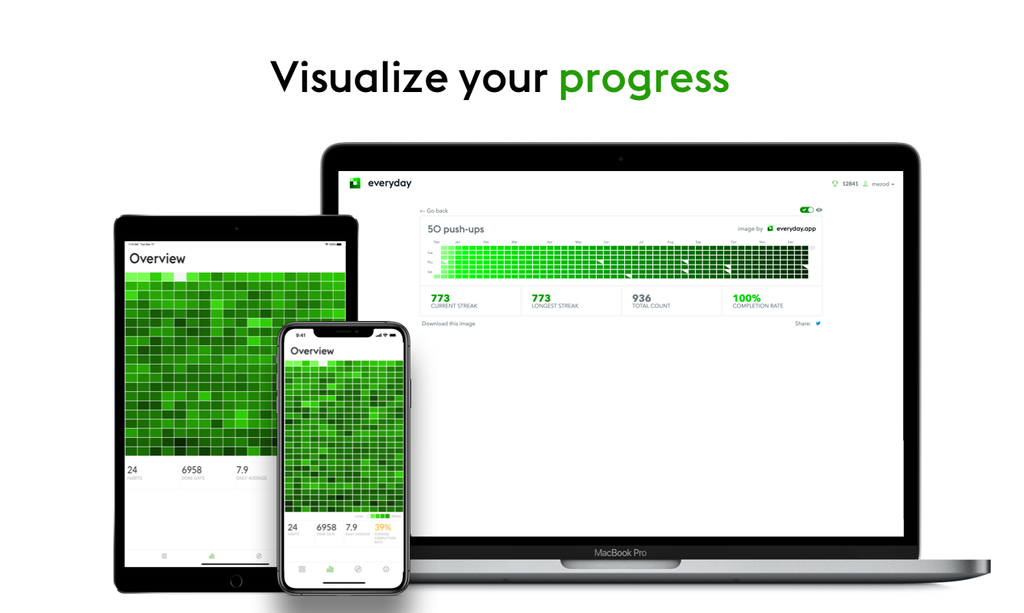
Why progress visualization works so well
A lot of people think habits mostly come down to willpower. But behavior science usually points somewhere else. Good systems often work better than random bursts of motivation. A visual tracking system creates a simple loop: do the action, mark it done, notice the progress, then do it again.
A 2024 peer-reviewed study of 41 digital habit intervention studies found that prompts and cues appeared in 80% of studies, goal setting in 65%, self-monitoring in 60%, and feedback on behavior in 56% (Journal of Medical Internet Research). Progress visualization can support several of these at once. It can act as a cue, and gives you a record of what you did, along with feedback you can see right away.
Habit tracking provides visual proof of your hard work, a subtle reminder of how far you've come.
That kind of visual evidence is a huge help. A lot of habits do not give instant results. One workout does not make you fit. One study session does not guarantee an A. Going to bed early for one night does not suddenly fix your energy. A tracker helps make the process visible, even when the payoff is not obvious yet.
This also helps explain why small habits can work so well. When a habit is small enough to repeat often, you get more chances to log a win. Small, but still meaningful. Over time, those wins build trust. Then the thought shifts from “I should be more consistent” to noticing that you already have been.
What a visual habit tracker actually shows you
A good tracker does more than store data. It makes behavior visible. Most people aren’t going to stare at numbers for ten minutes (although feel free to do so!), and the good news is that you don’t need to.
The most useful things to visualize are:
- Current streak so it is easy to see momentum grow
- Longest streak so there is a personal best to work toward
- Total completions so progress feels bigger than a single day
- Weekly consistency so rough patches are easier to spot
- Monthly trends so longer-term change is easier to see over time
- Skipped days so flexibility does not slowly turn into quitting
Many modern tools now include streaks, progress bars, dashboards, completion percentages, and other kinds of visual feedback because people want to see how they are doing. And this is not limited to productivity. It shows up in wellness tools too. People want to check hydration, walking, sleep, meditation, reading, focus time, and planning habits in one place, which makes sense.
In practice, a visual habit tracker works a lot like a mirror. It reflects behavior back in a way that is simple but useful. If weekends are consistently blank, that often points to where something needs to change. If one habit keeps breaking, it may be too big or too unclear. And when one small habit stays steady for months, that is usually a sign the system is working.
That is why many people do better tracking actions instead of outcomes. Rather than tracking “be healthier,” track “walk for 10 minutes.” That goes a long way towards making them easier to keep doing day after day.
If you want more ideas for what to measure, we covered that here in Habit Tracker Ideas: What to Track (and How to Stick With It). You can also explore related progress visualization strategies in Daily Routines: How to Track Your Habits for Maximum Impact.
The motivation loop: see it, feel it, repeat it with progress visualization
The main reason people track habits usually isn’t the data. It’s the feeling that comes from seeing progress grow. That visible progress feels good, and that small reward in the moment can help the behavior stick, which people often don’t realize.
Habit tracking is powerful for three reasons. 1. It creates a visual cue that can remind you to act. 2. It is motivating to see the progress you are making. 3. It feels satisfying to record your success in the moment.
It’s easy to miss why this works. Checking off a habit gives you a sense of closure right away, almost like a small reward, which is really important because many worthwhile goals take weeks or months before results are easy to see.
Take two people trying to build the same routine.
- Person A says, ‘I want to read more.’
- Person B reads one page each day, then checks it off on a board.
After three weeks, Person B has not only read more. They also have evidence. There’s a visible chain of completed days, and they can actually see their effort adding up. That kind of proof often builds momentum because it’s right there in front of them, not just something they hope is happening.
This becomes even more useful when life gets busy. Students might miss a day during exams. Professionals often fall off when deadlines pile up. Parents can lose their routine during a hectic week. A visual habit tracker makes it easier to restart because the habit is still visible on the board, in the app, or wherever it’s being tracked. Instead of feeling like you’re back at zero, you’re coming back to something already in motion.
Best habits to track when you want real results
The best habits to track are usually the ones that feel clear, repeatable, and tied to a bigger goal, at least most of the time. What works best is keeping things simple!
Here are some good options for different people:
Wellness habits
- A glass of water before anything else in the morning
- Ten minutes of walking outside or on the treadmill
- Five minutes of stretching, first thing or last thing
- A fixed bedtime – the same one on weekends
- Phone out of the bedroom overnight
Productivity habits
- Write tomorrow’s first task before you close the laptop for the day
- One distraction-free block in the morning, no exceptions
- Check email twice – once mid-morning, once before logging off
- Fifteen minutes on the project you keep avoiding
- A two-minute end-of-day desk tidy
Learning habits
- One page of a book. If that’s too much, make it one paragraph
- Five minutes reviewing yesterday’s notes before adding new ones
- Ten minutes of deliberate practice on one specific skill
- A single sentence summarising what you learned, written that day
- One question you didn’t know the answer to, looked up properly
Personal growth habits
- One line in a journal – good day or bad
- A small, fixed amount into savings, automated if possible
- A message to someone you haven’t spoken to in a while
- One area of the flat tidied, however small
- Ten minutes of something that isn’t a screen
The main idea is to start even smaller than feels necessary. Really small, seriously! A lot of habits fall apart because they start too big. People write “exercise daily” when what they probably need is “put on workout shoes and move for 5 minutes.” They also write “study every night” when what often works better is just “review one flashcard set.”

Smaller habits give you more completions. That gives you more evidence that you can keep going. When you have something clear and real to notice, motivation often has a better chance to build over time.
If it’s unclear which small habits create the biggest ripple effect, keystone habits often improve several parts of life at once, like your energy and routines. We cover that here if you’re interested in learning more: The Power of Keystone Habits: Transform Your Daily Routines.
How to track habits sustainably with progress visualization
If you want to track habits in a way that really lasts, keep the system simple. The trackers that last aren’t the clever ones. They’re the ones boring enough that you don’t notice you’re still using them six months in. Build for boredom.
1. Pick one habit. Maybe two.
Most people try to track six and quit within a fortnight. The problem isn’t discipline – it’s surface area. Every habit you add is another small obligation to feel guilty about. Start with one. Add the second only when the first feels automatic.
2. Make the habit specific enough to tick off
“Read more” isn’t trackable. “Read one page before bed” is. The test is whether you can answer yes or no at the end of the day without negotiating with yourself.
3. Bolt it onto something you already do
New habits don’t survive in isolation. They survive when they ride on the back of existing ones – brushing teeth, making coffee, shutting the laptop. Pick a moment that already happens without thinking, and wedge the new habit directly after it. The existing routine becomes the reminder.
4. Log it immediately, not later
Tick the box while you’re still standing in the kitchen, not three hours later from the sofa. The delay isn’t logistical – it kills the feedback that makes tracking worth doing. Put the tracker where the habit happens: phone on the counter, for example. Logging should feel like part of the action, not arduous admin!
5. Look at the week, not the day
Daily check-ins tell you what happened. Weekly reviews tell you why. A bad Wednesday means nothing on its own; four bad Wednesdays in a row is a pattern, and patterns are the only thing worth acting on. Most of what looks like a motivation problem turns out to be a calendar problem once you can see a fortnight at a time.
Everyday is built around one clear idea: work on your goals, every day. Perfection isn’t needed, but showing up is required. This doesn’t have to be a big, scary commitment though – thinking small actually achieves bigger results. But you’ve gotta do it every day!
Advanced ways to use progress visualization without overcomplicating it
Once the basics are in place, the tracker can be used in smarter ways without making it a whole project. Advanced analytics usually aren’t needed. Still, a few simple patterns can, in most cases, help the system work better and likely feel easier to use.
Track consistency, not intensity
When building habits, a short walk done 20 times is usually better than one hard workout, even if that one session feels impressive, followed by two weeks of nothing. Small steps often matter more here. And a tracker should reward just showing up, day after day.
Use trend views to spot friction
Monthly views can show where habits often fall off, which helps. Maybe travel throws off a morning routine, or stress messes up an evening one. But this usually isn’t about judging yourself. It’s about changing the setup instead (I think that’s the key).
Separate life areas
Some people do better when they split habits into groups like wellness, work, learning, and home stuff. It’s often easier to spot patterns that way, which honestly helps day to day. It can also stop one weak area from making the whole system feel broken, or at least less off.
Keep the board visible across devices
A habit is easier to remember when the tracker stays somewhere you can see it. Cross-device access helps here too, so your progress doesn’t disappear when you switch from your phone to a laptop or use a tablet. Everyday has you covered here!
Use skips wisely
Flexible systems often work better over time. If you’re planning to skip for travel, illness, or extra busy days, which happens, that will likely help you keep the habit instead of quitting it completely. A small buffer can help with that.
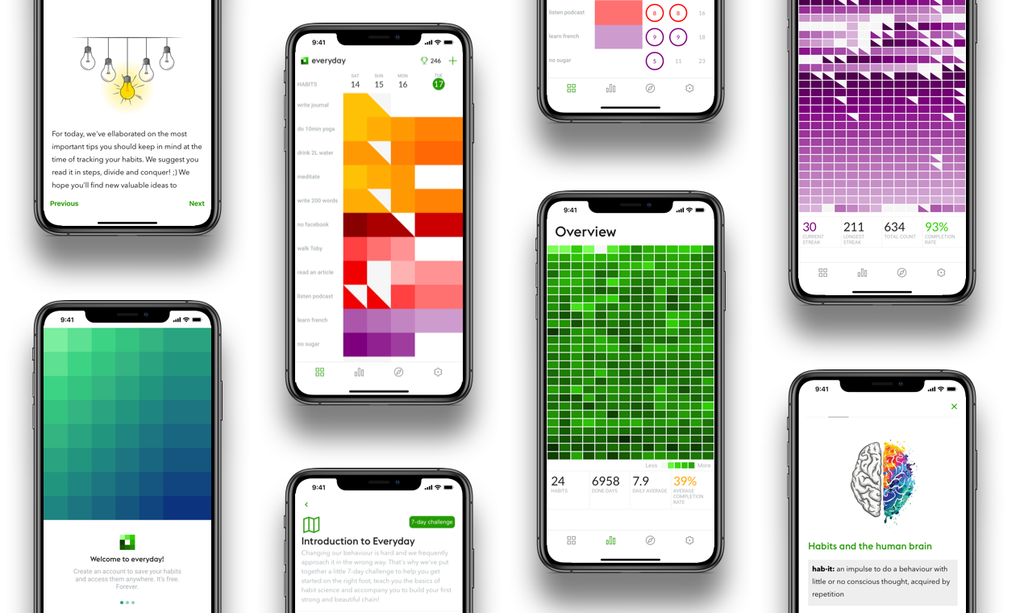
Some mistakes people make when they start to track habits
Habit tracking is simple, but a few common mistakes can make it feel frustrating. We don’t want that!
Tracking too many habits
Trying to fix your whole life at once can make the tracker feel really heavy. That happens a lot. So it often helps to start with one or two habits first and build some success there.
Choosing habits that are too big
If a habit feels hard on low-energy days, it probably needs to be smaller. A mini habit usually feels easier to repeat and keep up with. It’s also often easier to log regularly, which honestly helps.
Treating one miss like a total failure
One blank square usually isn’t the end, really, it probably isn’t. It’s just one miss. But lots of people lose motivation when a small slip feels like proof that everything has stopped, and that’s pretty common.
Focusing only on streak length
Streaks are great, they really are. But they’re not the only thing that matters: total completions and weekly patterns matter too, and long-term improvement usually matters too.
Forgetting to review
Tracking without review often turns into just collecting marks, and that happens a lot. Each week, take a minute to ask: What worked? What broke? What should probably shrink?
A visual system should help you feel informed, not judged. If your tracker creates constant pressure, it should probably be simpler. That’s it.
Your Questions, Answered
What is progress visualization in habit tracking?
It’s the bit where your effort becomes visible – a row of ticks, a streak counter, a filled-in calendar square. The action itself doesn’t change, but seeing it logged gives the brain something to latch onto.
How many habits should I track at once?
One or two. Three if you’re feeling ambitious and at least one of them is genuinely trivial. People overload the tracker in week one and abandon it by week three – the maths is unforgiving.
What should I do if I miss a day?
Miss one, not two. That’s the rule most behaviour researchers land on. If you skip Tuesday, Wednesday is non-negotiable – not because one day matters, but because two in a row is how a habit quietly dies.
Now it is your turn
If you want better routines, start with something so small you’d be embarrassed to call it a habit. Log it! The evidence is what does the work.
A few things worth holding onto from this piece:
- Visualisation isn’t motivation. It’s feedback – a signal that the action happened, delivered before any real-world payoff arrives.
- The size of the habit matters more than the ambition behind it. A page beats a chapter. A glass beats a litre.
- Two or three trackable habits is plenty. Ten is a spreadsheet, not a practice.
- Weekly reviews are where the system survives contact with real life. Skip them and the tracker becomes decoration.
Pick one habit. Do it now if you can – water, a page, two minutes of stretching. Tick it off. That tick is the whole point.Then watch the chain grow. Over time, that chain can become more than a record. It becomes evidence that you can trust yourself.
When you track habits in a visible way, motivation usually feels less confusing. You build it one small win at a time, and you will probably notice your progress more clearly.
With Everyday, getting comfortable with how to track habits fits into your day as a quick check‑in that takes about a minute; it’s not a chore or a burden. So pick one habit. Do it today. Track it over the next week, then adjust it based on what your energy is telling you. That makes it easier to build something you can actually stick with. Every day!